WhatsApp:
+1 (413)758-9837
Address:
United Kingdom
WhatsApp:
+1 (413)758-9837
Address:
United Kingdom

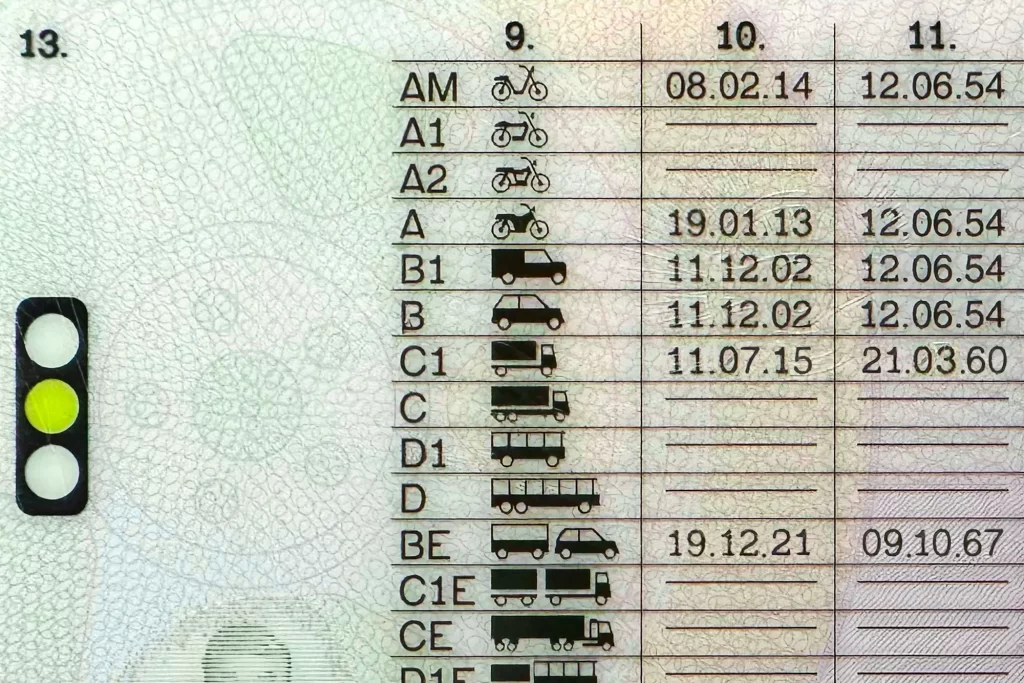
Look at the back of your photocard licence and you’ll see a grid of letters and numbers most people never decode AM, B, BE, C1, D1E, and so on. Each one is a specific legal entitlement, and misunderstanding them is exactly how people end up driving something they’re not actually licensed for. This is UK driving licence categories explained properly, from the everyday car entitlement through to HGVs, buses, and motorbikes.
Where to find your categories: turn your photocard over section 9 lists every category you currently hold, alongside the dates each was issued and expires.
What licence categories actually are: legal classifications of vehicle types, each requiring its own entitlement either automatically granted, provisionally held while learning, or gained by passing a specific test. UK Driving Licence Categories Explained
What is Maximum Authorised Mass (MAM)? The maximum permitted weight of a vehicle (or vehicle-and-trailer combination), including the vehicle itself plus its maximum load not just the empty “kerb weight.” MAM is the figure that actually determines which licence category you need, not how big a vehicle looks. UK Driving Licence Categories Explained
How entitlements work:
What Category B actually allows:
Can you drive a van on a car licence? Yes provided the van’s MAM doesn’t exceed 3,500kg. Many common panel vans fall within this limit; larger long-wheelbase or heavy-duty vans may not, so always check the vehicle’s specific MAM, not just its general size.
Can you drive a motorhome? Yes, provided its MAM is 3,500kg or under. Larger “coach-built” motorhomes frequently exceed this and require Category C1 instead this catches out more new motorhome owners than almost anything else in this category. UK driving licence categories
Can you drive an automatic? Yes, but passing your test in an automatic restricts your licence to automatic vehicles only. Pass in a manual, and you’re licensed for both.
Passenger limits: up to 8 passengers in addition to the driver — anything beyond that moves into Category D territory, covered further down. UK driving licence categories
Automatically included with Category B:
This is the section that generates the most genuine confusion, partly because the rules have changed twice in recent years.
Current rules (since 16 December 2021, Great Britain):
Northern Ireland operates separate rules always check DVA guidance specifically if you’re towing there, rather than assuming GB rules transfer directly. UK driving licence categories
If you passed your car test before 1 January 1997 “grandfather rights”:
If you passed between 1 January 1997 and 15 December 2021:
What Category B/BE still does NOT cover: towing a trailer with a MAM over 3,500kg. For anything heavier than that a large horsebox, a substantial plant trailer you need Category C1+E, which requires passing the relevant HGV-adjacent test. UK driving licence categories
Towing quick-reference:
| Category | Vehicle Type | MAM | Trailer Rule |
|---|---|---|---|
| C1 | Medium-sized goods vehicles | 3,500kg–7,500kg | Trailer up to 750kg |
| C1E | C1 vehicles with larger trailers | 3,500kg–7,500kg | Trailer over 750kg, combination up to 12,000kg |
| C | Large rigid goods vehicles | Over 3,500kg (no fixed upper limit) | Trailer up to 750kg |
| CE | Full articulated/large combinations | Category C vehicle | Trailer over 750kg (articulated lorries, drawbar combinations) |
Typical jobs requiring each category:
| Category | Vehicle Type | Passenger Limit | Trailer Rule |
|---|---|---|---|
| D1 | Minibuses | Up to 16 passengers plus driver | Trailer up to 750kg |
| D1E | D1 with larger trailers | Up to 16 passengers plus driver | Trailer over 750kg, combination up to 12,000kg, trailer laden weight not exceeding the towing vehicle’s unladen weight |
| D | Buses and coaches | More than 8 passenger seats (typically well over 16) | Trailer up to 750kg |
| DE | D with larger trailers | Same as D | Trailer over 750kg |
Driver CPC requirements: anyone driving Category C or D vehicles professionally, for hire or reward, needs the Driver Certificate of Professional Competence in addition to the category entitlement itself this isn’t optional for professional driving, regardless of how long you’ve held the underlying licence category.
Buy HGV licence,Buy HGV licence UK ,Buy LGV licence , Buy LGV licence UK ,HGV licence cost , LGV licence cost LGV training near me ,HGV training courses ,LGV training courses , HGV licence training
An important note on D1 acquired rights: if you hold D1 or D1E only through pre-1997 acquired rights (rather than having passed the actual D1 test), you cannot act as a supervising driver for someone learning on a provisional D1 licence a genuinely easy-to-miss restriction.
Category AM mopeds:
Category Q: covers certain light two- or three-wheeled vehicles distinct from standard mopeds — a niche category most riders won’t encounter directly; check current GOV.UK specifications if this applies to your specific vehicle.
Motorcycle categories:
| Category | Minimum Age | Power/Engine Limit |
|---|---|---|
| A1 | 17 | Up to 125cc and 11kW |
| A2 | 19 | Up to 35kW |
| A | 24 (direct access) or 21 (progressive access) | Any motorcycle, no power limit |
Progressive access rules: riders can reach full Category A from age 21, provided they’ve already held an A2 licence for a minimum of two years. Alternatively, the Direct Access Scheme (DAS) lets riders aged 24 or over go straight to Category A without holding A1 or A2 first.
Automatic-only licences: a licence gained in an automatic vehicle doesn’t cover manual vehicles this applies identically across car and motorcycle categories.
Medical restrictions: certain categories (particularly C1, C1E, D1, D1E and above) require meeting higher medical standards than a standard Category B licence, reflecting the greater responsibility of driving larger vehicles or carrying passengers professionally.
Licence codes: beyond category letters, your licence may show additional numeric codes (such as requirements to wear glasses, or vehicle adaptations) these appear alongside your category entitlements and are legally binding conditions, not just notes.
What does Category B mean? Category B covers standard cars and light vans up to 3,500kg MAM, with up to 8 passenger seats, plus a trailer up to 750kg unconditionally (or up to 3,500kg automatically since December 2021).
Can I drive a van? Yes, on a Category B licence, provided the van’s Maximum Authorised Mass doesn’t exceed 3,500kg. Larger vans may require Category C1 instead.
Can I tow a trailer? Yes. Since December 2021, all Category B licence holders can tow trailers up to 3,500kg MAM automatically, with the vehicle-and-trailer combination up to 7,000kg, without a separate test.
What is MAM? Maximum Authorised Mass the maximum permitted weight of a vehicle or vehicle-and-trailer combination, including its maximum load, not just its empty weight.
Do I need Category BE? Not as a separate step since December 2021 it’s now automatically included with Category B for towing up to 3,500kg. It may only show explicitly on your photocard after your next renewal.
What licence is needed for an HGV? Category C1 (3,500–7,500kg), Category C (over 3,500kg rigid), or Category CE (articulated lorries), depending on the specific vehicle and trailer combination.
Can I drive a minibus? With Category D1, covering minibuses up to 16 passengers plus the driver. Larger passenger vehicles require full Category D.
What’s the difference between C1 and C? C1 covers vehicles between 3,500kg and 7,500kg MAM. Category C covers rigid goods vehicles over 3,500kg with no fixed upper limit.
Which motorcycle licence do I need? Depends on age and the machine’s power output: A1 (17+, up to 125cc/11kW), A2 (19+, up to 35kW), or full Category A (21+ via progressive access, or 24+ via Direct Access).
How do I check my licence categories? Use the free “view or share your driving licence” service on GOV.UK, or check section 9 on the back of your physical photocard.
Understanding UK driving licence categories properly comes down to a handful of genuinely important distinctions: MAM determines your vehicle limits far more than a vehicle’s apparent size, towing rules changed significantly in December 2021 in most drivers’ favour, and pre-1997 grandfather rights carry real, valuable entitlements that are worth double-checking on your current photocard. Whatever you’re planning to drive next — a bigger van, a trailer, an HGV, or a motorcycle upgrade — check your actual entitlement against official GOV.UK guidance before assuming your existing licence covers it.